
A fall can happen in an instant. A wet grocery-store floor, an icy parking lot, a broken step, poor lighting, a hidden change in elevation, or debris left in a walkway can cause injuries that last for months or years. These are not always “just accidents.” When a dangerous condition on property causes an injury, Michigan law may hold the person or business responsible for the property legally accountable.
At Shafer Swartz, PLC, we represent people injured because property was not kept reasonably safe. Premises-liability cases include slip-and-falls and trip-and-falls, but they can also involve unsafe stairs or railings, falling objects, inadequate maintenance, dangerous walkways, ice and snow, and other hazardous conditions. The important question is not simply whether you fell. It is why you fell, what made the property dangerous, what the property possessor knew or should have known, and whether reasonable steps were taken to protect you.
Michigan Premises-Liability Law Changed in an Important Way
For many years, Michigan’s “open and obvious” doctrine was often used to dismiss premises-liability cases at an early stage. In 2023, the Michigan Supreme Court changed that framework in Kandil-Elsayed v F & E Oil, Inc., 512 Mich 95 (2023).
The Court reaffirmed that a land possessor owes a business invitee a duty to exercise reasonable care to protect against an unreasonable risk of harm caused by a dangerous condition of the property. The Court also held that whether a danger was open and obvious generally is no longer a question that eliminates the property possessor’s duty. Instead, the obviousness of the danger is considered when deciding whether the property possessor acted reasonably and, where appropriate, whether the injured person was comparatively at fault.
That change matters. A store, restaurant, apartment complex, hotel, business, or other property possessor cannot automatically avoid responsibility merely by arguing that the hazard could have been seen. The facts still matter: how dangerous was the condition, how apparent was it, how long had it existed, what did the property possessor know or have reason to know, and what could reasonably have been done to correct it or protect visitors?
What Must Be Proven in a Michigan Premises-Liability Case?
Every case is fact-specific. For a customer or other business invitee, the general rule is that a property possessor must use reasonable care to protect invitees from unreasonable risks of harm caused by dangerous conditions on the property. A successful claim ordinarily requires proof of a dangerous condition, a duty owed to the injured person, a failure to use reasonable care, causation, and damages.
Notice is often a major issue. In many cases, the injured person must establish that the property possessor created the dangerous condition, actually knew about it, or should have discovered it through reasonable care. Evidence showing how long a spill, defect, accumulation, or other hazard existed can therefore become critically important.
The legal duty can also depend on why the injured person was on the property. Michigan law continues to distinguish among invitees, licensees, and trespassers, and different rules can apply to each category. Claims involving landlords, common areas, governmental property, or workplace injuries can involve additional statutes, defenses, notice requirements, or deadlines. That is one reason early legal review is important.
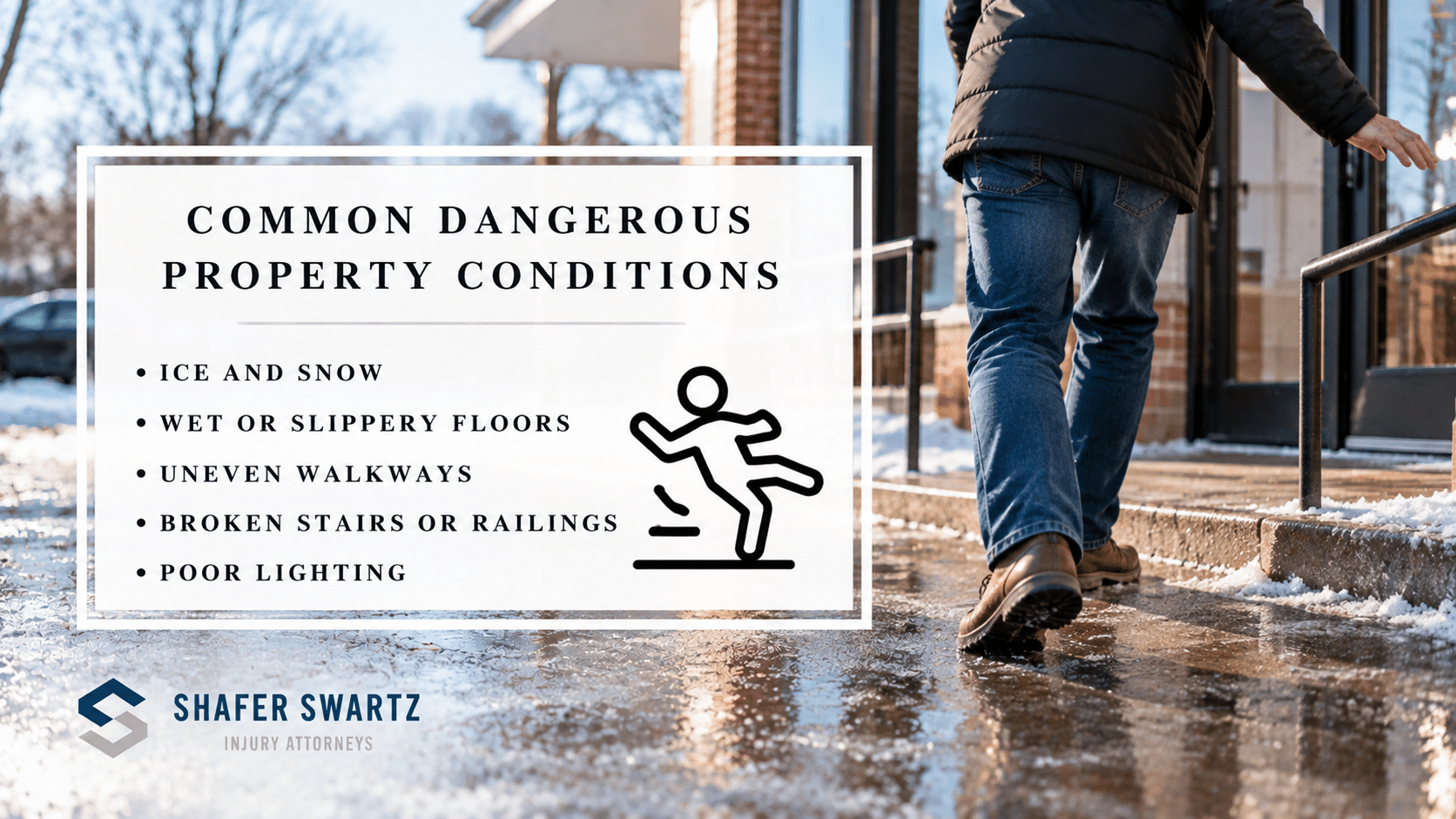
Common Dangerous Property Conditions
Premises-liability claims are not limited to a freshly mopped floor. Serious injuries can result from many kinds of unsafe property conditions, including:
- Ice, snow, or black ice in parking lots, sidewalks, entrances, and walkways.
- Water, grease, food, or other liquids on floors.
- Broken, uneven, raised, or deteriorated sidewalks and pavement.
- Unsafe stairs, steps, ramps, handrails, or guardrails.
- Poor lighting that makes a hazard difficult to see.
- Holes, depressions, abrupt changes in elevation, or concealed drop-offs.
- Mats, rugs, cords, merchandise, debris, or other objects creating a tripping hazard.
- Falling merchandise or objects that were improperly stored or secured.
- Dangerous conditions in apartment buildings, hotels, restaurants, stores, parking structures, and other commercial properties.
Michigan Winters: Ice and Snow Cases
West Michigan weather makes ice-and-snow cases especially important. Under Michigan law, a property possessor may have a duty to use reasonable care to protect an invitee from hazards caused by the natural accumulation of ice and snow. Reasonable care can require reasonable measures, within a reasonable time after an accumulation, to reduce the hazard.
An icy sidewalk or parking lot is not automatically a winning case, and it is not automatically a losing case. The analysis depends on the particular circumstances: the weather, the condition of the surface, the timing of snow or ice accumulation, inspection and maintenance practices, salting or plowing efforts, lighting, drainage, warnings, and what the property possessor knew or should have known.
What Should You Do After a Fall or Other Injury on Dangerous Property?
The evidence in a premises-liability case can disappear quickly. A spill can be cleaned. Snow and ice can melt. A broken step can be repaired. Surveillance video can be overwritten. Witnesses can leave before anyone gets their names. If you are physically able, these steps can help preserve important evidence:
- Seek appropriate medical care and describe accurately how the injury occurred.
- Report the incident to the property owner, manager, or business and ask that an incident report be completed.
- Photograph and video the exact hazard and the surrounding area from several angles before the condition changes.
- Get the names and contact information of witnesses.
- Keep the shoes and clothing you were wearing and do not alter or discard them.
- Write down what happened while your memory is fresh, including anything employees or witnesses said.
- Contact an attorney promptly so that important evidence, including surveillance footage and maintenance or inspection records, can be requested and preserved.
What Compensation May Be Available?
A serious premises injury can affect far more than the first emergency-room visit. Depending on the facts and the injuries, recoverable damages may include medical expenses, lost wages and loss of earning capacity, pain and suffering, disability, scarring or disfigurement, and loss of the ability to participate in activities and enjoy life as before. In the most serious cases, a dangerous property condition can cause permanent disability, traumatic brain injury, fractures requiring surgery, spinal injuries, or death.
Michigan’s Comparative-Fault Rules Can Matter
Property owners and insurance companies often argue that an injured person should have seen or avoided the condition. After Kandil-Elsayed, that argument does not automatically erase the property possessor’s duty to an invitee. But the injured person’s own conduct can still matter under Michigan’s comparative-fault rules and may reduce the damages that can be recovered. The focus should be on the complete circumstances, not a photograph taken after the accident with the hazard circled or highlighted.
Do Not Wait to Investigate a Michigan Premises-Liability Claim
Michigan generally provides a three-year limitations period for actions seeking damages for personal injury. But waiting anywhere near three years can seriously damage a premises-liability case. Evidence disappears, video is erased, property conditions change, employees move on, and witnesses become harder to locate. In addition, shorter deadlines or special notice rules can apply in certain cases, including claims involving governmental property. The safest approach is to investigate promptly rather than assume that the general three-year period will protect every claim.
Talk With a Muskegon Premises-Liability Attorney
If you were seriously injured in a slip-and-fall, trip-and-fall, or another incident caused by dangerous property in Muskegon, West Michigan, or elsewhere in Michigan, Shafer Swartz, PLC can evaluate what happened and determine whether a premises-liability claim should be pursued. We understand that these cases often turn on details that must be investigated early: photographs, surveillance video, incident reports, inspection procedures, maintenance records, weather information, witness testimony, and the history of the dangerous condition.
Call Shafer Swartz, PLC at (231) 722-2444 to discuss your case. There is no substitute for evaluating the actual facts, and the sooner a serious premises-liability claim is investigated, the better the opportunity to preserve the evidence needed to prove it.