
Motorcycle accidents in Michigan continue to be a serious concern. Recent data shows that motorcycle-involved crashes rose to 3,187 in 2024, an increase of 4% from the previous year, while motorcyclist fatalities climbed by 2%, reaching 168 deaths statewide. These numbers highlight the fact that you’re far more vulnerable on a motorcycle, especially when other drivers fail to respect your space on the road.
Many of these accidents involve motorcycle right-of-way violations. That’s why riders often ask, “Do motorcycles have the right of way?” Under Michigan law, the answer is yes, motorcycles are classified as motor vehicles and have the same rights and responsibilities as any other car or truck on the road. When a driver ignores those rights, the consequences can be life-altering for the injured rider.
Let our competent Muskegon motorcycle attorney explain how Michigan motorcycle right-of-way works and what you need to know when proving fault after a crash.
Understanding Motorcycle Right of Way Under Michigan Law
Michigan right-of-way laws are designed to keep road users safe and traffic predictable. These rules apply equally to cars, trucks, and motorcycles. Here are the key situations where motorcycles receive the same right-of-way protections:
- Intersections
A driver must yield the right of way to any vehicle that has already entered the intersection from a different road. If two vehicles arrive at the same time, the driver on the left must yield to the one on the right.
- Left Turns at Intersections
When a driver intends to turn left at an intersection, that driver must yield to vehicles coming from the opposite direction that are already in the intersection or close enough to pose an immediate hazard.
- Left Turns Outside Intersections
A driver turning left across opposing lanes at any location other than an intersection must yield to oncoming traffic that’s so close to the driver as to constitute an immediate hazard.
- Roundabouts
Roundabouts operate on a simple rule: vehicles already circulating within it have the right of way. If you are already in the roundabout, all drivers entering must wait until it’s safe.
When a driver violates motorcycle right-of-way, collisions often happen, and because motorcycles are smaller and have less physical protection than cars, the impact can result in catastrophic injuries, such as broken bones, spinal trauma, or traumatic brain injuries, and even wrongful death.
Common Types of Right-of-Way Violations
Recognizing motorcycle right-of-way violations can help you stay alert and prove fault if you’re ever involved in an accident. Here are the most common violations that lead to personal injury claims:
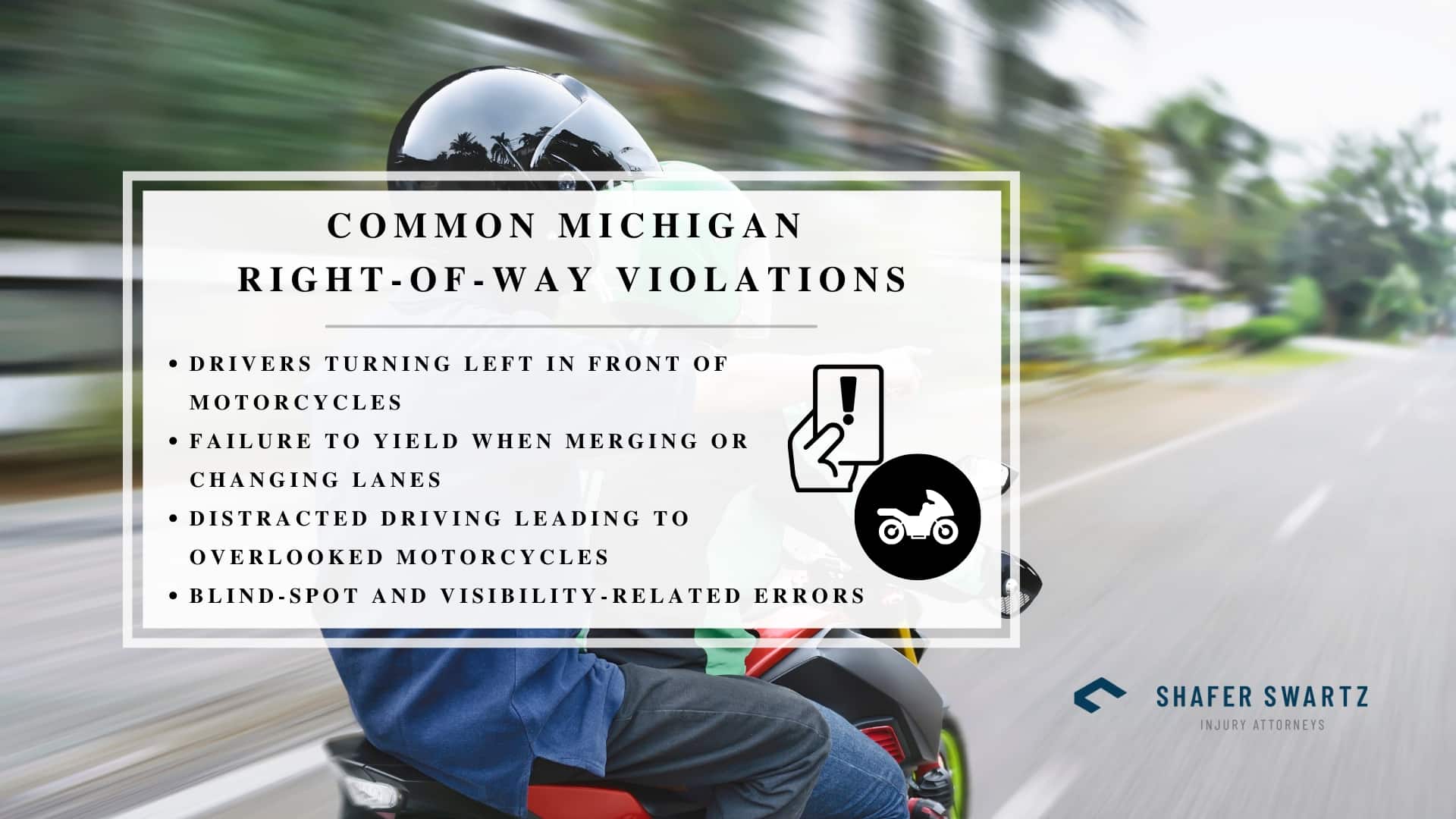
- Drivers Turning Left in Front of Motorcycles
A driver turns left at an intersection or driveway and cuts directly across your path. Many of these violations happen because the driver assumes there’s enough time to complete the turn, but misjudges the speed of the motorcycle, often resulting in severe crashes.
- Failure to Yield When Merging or Changing Lanes
Motorcycles are smaller and can be harder to spot, but that doesn’t excuse drivers from checking their mirrors and blind spots before merging. When a vehicle moves into a lane already occupied by a motorcycle, it’s a direct motorcycle right-of-way violation.
- Distracted Driving Leading to Overlooked Motorcycles
Phones, infotainment systems, and other in-car distractions have made the roads increasingly dangerous for riders. A distracted driver looking away for just a second can easily miss a motorcycle approaching an intersection or traveling in the adjacent lane.
- Blind-Spot and Visibility-Related Errors
Motorcycles fit easily into blind spots, and poor weather or low-light conditions make them even harder to see. Drivers must take extra care to check mirrors and over-the-shoulder views before turning or changing lanes. Failure to do so can cause serious collisions.
Michigan law expects every driver to be alert and aware of their surroundings. Riders can improve their own visibility with advanced motorcycle technology, such as reflective gear or adaptive headlights, but the duty to yield and check for other vehicles always remains with the driver making the maneuver.
How Fault Is Determined in Motorcycle Right-of-Way Crashes
After a motorcycle crash, insurance companies often try to shift part of the blame onto the motorcyclist. That’s why you need solid evidence to show that another driver failed to yield and caused your injuries. These pieces of evidence can help establish what happened and who was responsible:
- Dashcam Footage
More riders and drivers are using dashcams today, and the footage can instantly clarify what exactly happened. A dashcam might show that a driver turned left in front of your motorcycle, merged into your lane without looking, or entered an intersection when you already had the right of way. Because video evidence is hard to dispute, it stands as a compelling tool to establish fault.
- Witness Statements
People who saw the crash unfold, including pedestrians, other motorists, or nearby workers, can provide valuable context. Many motorcycle right-of-way violations happen too fast for you to fully observe the actions of the other driver, so witness testimony can help fill in important details. Witness accounts can confirm that the driver failed to yield or was driving aggressively right before the collision.
- Accident Reconstruction
In more serious cases, expert witnesses can be brought in to recreate how the crash happened. Accident reconstruction specialists, for instance, review skid marks, vehicle positions, impact points, damage patterns, and speed estimates. Their findings can be especially helpful when the other driver denies responsibility or when insurance companies dispute your version of events.
Note that Michigan follows a comparative negligence system, meaning fault can be divided between both parties. If you’re found partially at fault, your compensation might be reduced by your percentage of fault. However, as long as you are less than 51% at fault, you can still recover damages for pain and suffering and other non-economic losses.
Furthermore, insurance adjusters act quickly to gather statements and push for early settlements after a serious crash. Without legal guidance, you might accept a low offer that doesn’t reflect the true extent of your injuries or losses. A local Muskegon motorcycle attorney can make sure you’re treated fairly and fight for the compensation you deserve.
Why Motorcycle Accident Victims Need a Michigan Attorney
Motorcycle right-of-way violations often lead to accidents, injuries, and complicated insurance battles. When another driver ignores your right to the road, you shouldn’t have to shoulder the financial burden that follows. If you or a loved one has been injured in a motorcycle crash, Shafer Swartz PLC is here to guide you through the legal process and work toward the best possible outcome for your recovery.
We’re committed to protecting the rights of injured riders throughout Michigan. Our seasoned Muskegon motorcycle attorneys can investigate your case thoroughly, deal directly with insurance companies, and build a solid claim that reflects the real impact of your accident. Contact us today at (231) 722-2444 or here for a consultation. Let us help you secure the justice and compensation you need to move forward.