
After a car accident, the truth often depends on the evidence left behind. Photos, damaged vehicle parts, black box data, video footage, and phone records can all help show how the crash happened and who was at fault. But when that evidence is lost, deleted, repaired, or thrown away too soon, it can make a personal injury claim much harder to prove. In some situations, the missing evidence can even shift how the court views a case, especially if a party had a duty to preserve it.
Let our local Muskegon car accident attorney discuss how spoliation can affect Michigan car accident cases and what you can do to protect your claim.
What Spoliation of Evidence Means in Michigan Injury Cases
In Michigan, spoliation of evidence generally refers to the destruction, significant alteration, or failure to preserve evidence that may be relevant to pending or reasonably foreseeable litigation. In plain terms, it means critical proof is no longer available when it should have been kept. That can happen on purpose, such as when someone deletes a recording to hide what it shows, or by accident, such as when a vehicle is repaired before it is inspected or digital records are automatically erased.
Car accident claims often depend on details that cannot be recreated later. Once key evidence is gone, it might become harder for you to prove fault, challenge the other party’s version of events, or support the extent of your damages. The court might have to rely on incomplete facts, and that can affect the outcome of your personal injury case. Michigan law does not treat spoliation as a stand-alone tort claim, but courts can impose sanctions when the loss of evidence harms the fairness of the case.
Types of Evidence Commonly Lost or Destroyed
Many different forms of evidence can disappear quickly after a crash. Some are physical items that get repaired, discarded, or altered. Others are digital records that might be deleted automatically or lost because no one acted fast enough to preserve them. Here are the common types of evidence that may be lost or destroyed in car accident cases:
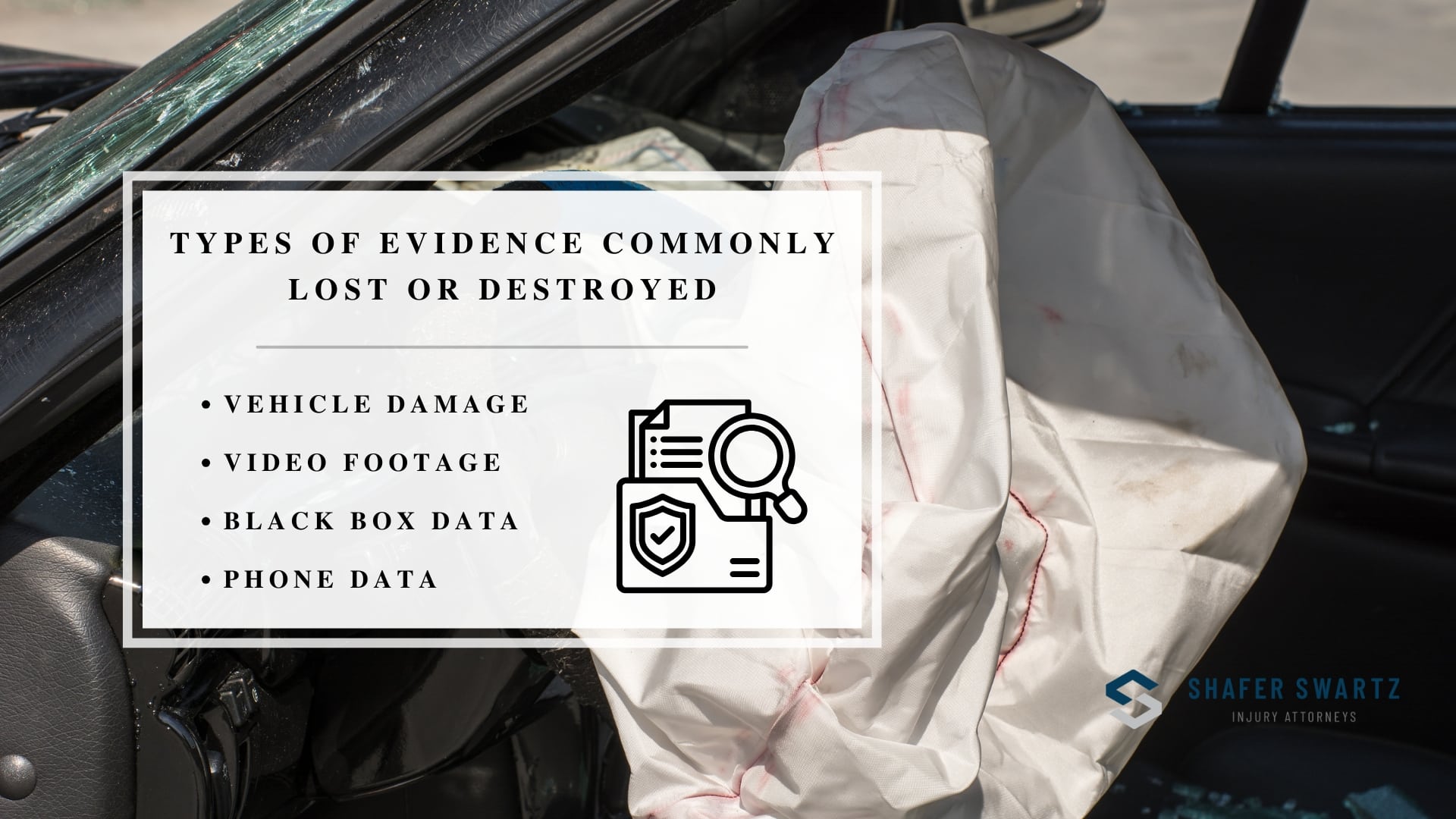
Vehicle Damage
Crush patterns, paint transfer, broken parts, airbag deployment, skid marks, and the location of the impact can all help experts understand how the accident happened. If a vehicle is repaired too soon, sold for salvage, or scrapped before it is inspected, that physical evidence might be gone for good. That loss can make it harder to prove speed, angle of impact, point of contact, or the force of the crash.
Video Footage
A dashcam might show the moments leading up to the collision, while traffic cameras, business security systems, or residential cameras might capture the crash itself or what happened right before it. The problem is that many video systems automatically overwrite footage after a short period. If no one requests or saves the recording, valuable evidence can disappear before your claim is fully underway.
Black Box Data
Many vehicles contain event data recorders (EDR), often referred to as black boxes, that store information such as speed, braking, seatbelt use, throttle position, and crash timing. In the right case, that data can help confirm or challenge what drivers say happened in the seconds before impact. But if the vehicle is destroyed, repaired, or not examined in time, that information might never be recovered.
Phone Data
Cell phone records and other electronic data can matter when distracted driving is suspected. Call logs, text activity, app usage, location information, and device extraction results might help show whether a driver was using a phone at or near the time of the crash. But electronic evidence can be lost through deletion, device replacement, overwritten data, or delays in sending preservation requests.
Legal Consequences of Spoliation in Michigan
Spoliation can change the balance of power during car accident litigation. When one side can show that key evidence disappeared after there was a duty to preserve it, that argument can make the opposing party look careless or dishonest. A strong spoliation claim might give the injured person more leverage in negotiations as the other party now faces added legal risk on top of the underlying car accident claim. On the other hand, if you are the one who lost the evidence, your position might become much harder to defend, especially if the court believes the missing proof could have helped establish fault or the severity of the crash.
Furthermore, the court might order sanctions that directly affect how the case moves forward. These can include compensatory or punitive fines, barring a party from offering certain testimony, or imposing an adverse inference or adverse presumption against the party that failed to preserve the evidence. In extreme situations, the court might dismiss the case or grant summary judgment. Still, Michigan courts do not impose the harshest penalties automatically, but weigh whether the evidence was material, how much fault or willfulness was involved, and how severely the missing evidence prejudiced the other side.
Protecting Your Case Through Early Evidence Preservation
The best way to reduce the risk of spoliation of evidence is to act quickly after a crash. Important proof can disappear fast, whether that means repaired vehicles, deleted footage, lost phone data, or missing black box information. Sending a spoliation letter right away can put the other side on notice that certain evidence must be preserved for a potential claim. The earlier you move, the better your chances of keeping critical evidence from being lost before your case is fully developed.
Shafer Swartz PLC is here to help you move faster and more effectively. Our competent Muskegon car accident attorney can identify what evidence matters most, send preservation notices, and take steps to document missing proof before it causes more damage to your case. We ensure to protect the proof you need and build a compelling case that clearly supports your right to compensation. Contact us today at (231) 722-2444 or here to schedule a consultation.