

If you’ve been injured in a Michigan car accident, you might assume that you can immediately sue the at-fault driver for your pain and suffering. However, the no-fault insurance system places limits on when you can bring such a lawsuit. The serious impairment threshold under MCL 500.3135, for instance, determines whether your injuries are significant enough to justify a claim for non-economic damages against the negligent driver.
Let our seasoned car accident attorney in Muskegon explain how Michigan law defines serious impairment of body function, why the threshold exists, and what it means for your personal injury claim.
What Is the Serious Impairment Threshold Under Michigan No-Fault Law?
Under the Michigan no-fault insurance law, your own insurance company typically pays for your medical expenses, lost wages, and certain replacement services after a car accident, regardless of who caused it. However, the injured person can pursue a car accident lawsuit against the at-fault driver for non-economic damages, such as pain and suffering, emotional distress, and loss of enjoyment of life, provided that said person has suffered death, serious impairment of body function, or permanent serious disfigurement.
A serious impairment of body function, as provided in MCL 500.3135, means an impairment that meets all of the following requirements:
- Objectively Manifested Impairment
The injury must be observable or perceivable by someone other than the injured person. In other words, it can’t be based solely on your personal feelings of pain. There must be medical evidence, such as imaging results or physician evaluations, that supports the injury.
- Impairment of an Important Body Function
The injury must affect a body function that holds great value, significance, or consequence to your daily life. For example, losing the ability to walk normally, use your hands, or see clearly would qualify as impairments of important body functions.
- Affect the General Ability to Lead a Normal Life
The injury must influence your capacity to live as you did before the accident. That doesn’t mean your life has to be completely turned upside down, but the impairment must make it difficult or impossible to engage in your usual daily activities, hobbies, or work.
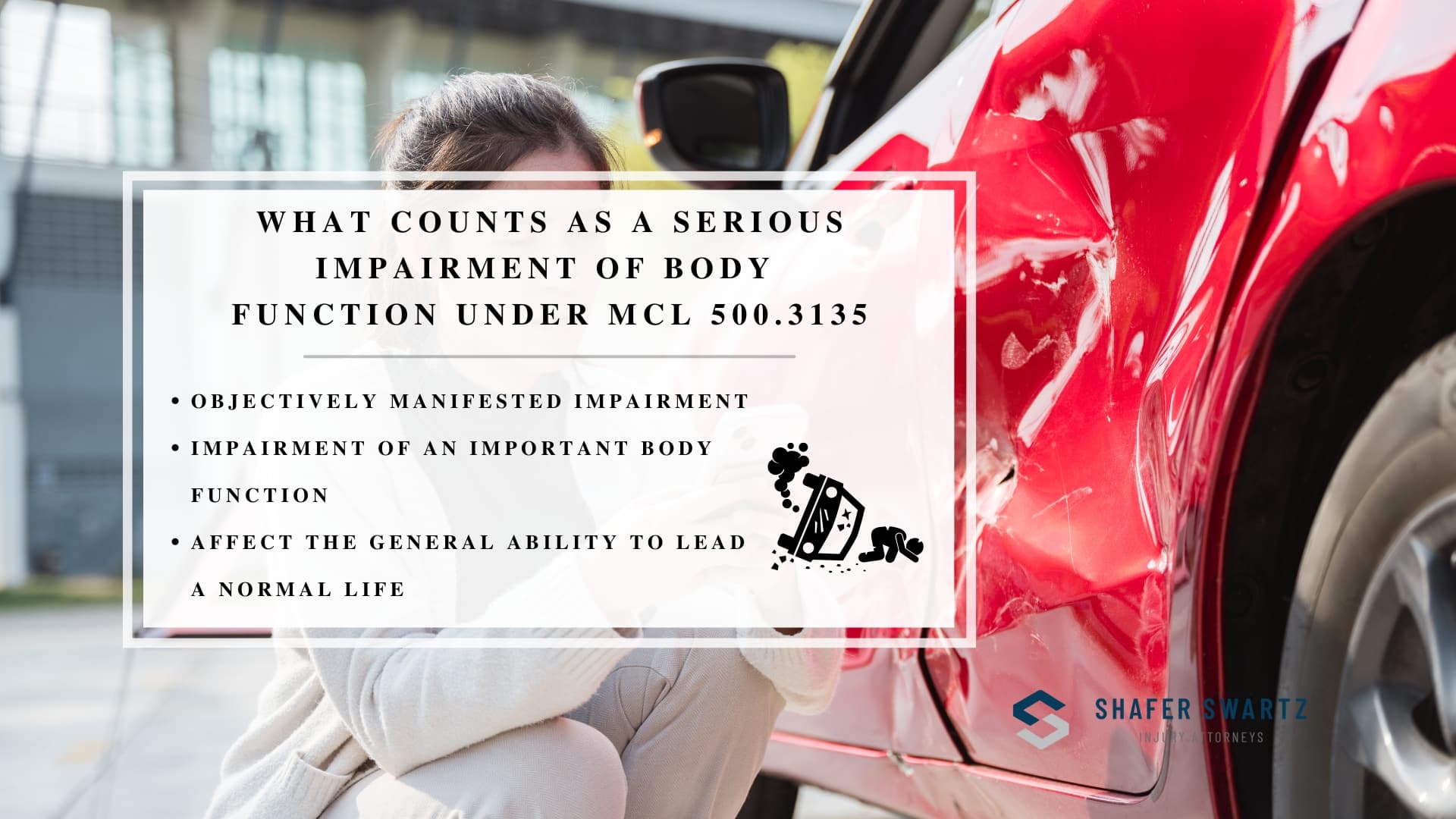
These three elements determine whether your injuries reach the serious impairment threshold. Courts analyze each case based on its unique facts, and there’s no fixed time requirement for how long the impairment must last. Even a temporary condition might qualify if it significantly affects your normal lifestyle.
Why the Serious Impairment Threshold Exists
The serious impairment threshold works alongside the Michigan no-fault rules to create a stable system for accident claims. No-fault insurance benefits cover economic losses, providing immediate relief to victims, while the threshold ensures that only cases involving significant, life-altering injuries proceed to legal actions. In essence, the threshold doesn’t block access to care, but simply guides which cases qualify for additional compensation beyond what no-fault insurance provides.
Before Michigan adopted the no-fault system, even minor injuries could lead to lengthy, costly litigation and delayed compensation for those truly in need. The serious impairment threshold ensures only injuries that truly affect the ability of a person to live their normal life qualify for non-economic damages. Moreover, the threshold helps keep insurance premiums more affordable for Michigan drivers because fewer minor cases go to court and insurers face fewer large payouts.
How Courts Interpret Serious Impairment
The MCL 500.3135 requires that the injury be objectively manifested, meaning it’s visible or provable through evidence other than your personal experience of pain. In other words, the injury must be something that doctors or others can observe, measure, or confirm through medical testing. Simply saying you’re in pain isn’t enough to prove a serious impairment. The court needs tangible evidence that your body is not working the way it used to and that others can see or medically verify such a change.
Injuries That Commonly Meet the Threshold
Common injuries that satisfy the serious impairment threshold in personal injury cases include:
-
- Herniated or bulging discs confirmed with imaging
- Fractures, such as broken arms, legs, ribs, or vertebrae
- Torn ligaments or tendons, such as ACL tears or rotator cuff injuries
- Nerve damage, resulting in loss of sensation, weakness, or mobility limitations
- Traumatic brain injuries, particularly when imaging or neurological exams support the diagnosis
These injuries often require extensive medical treatment, physical therapy, or even surgery, as well as limit your ability to work, exercise, care for your home, or participate in hobbies.
Injuries That Often Fail to Meet the Threshold
Some injuries, while painful or inconvenient, don’t usually meet the legal standard, such as:
-
- Minor sprains or strains
- Bruises and superficial wounds
- Short-term soreness after a low-impact collision
- Soft-tissue injuries without supporting imaging or objective findings
- Temporary pain that resolves quickly without significant lifestyle disruption
These injuries might still entitle you to no-fault benefits, but don’t justify a personal injury lawsuit for non-economic damages unless such injuries cause significant and lasting limitations.
Proving Serious Impairment in Michigan Car Accident Cases
Even if your injuries appear to qualify, you still need strong, organized evidence to prove serious impairment under MCL 500.3135. The burden is on you and your car accident attorney in Muskegon to show how your injury is objectively manifested, why it affects an important body function, and how it influences your ability to live your everyday life. Courts expect clear, consistent documentation to support your claim. Some of the strongest forms of evidence include:
- Medical Records
Comprehensive medical documentation is the backbone of your personal injury case. ER reports, hospital charts, imaging results, surgical records, and physician notes demonstrate the extent of your injury and ongoing treatment.
- Expert Witness Testimony
Expert witnesses, such as orthopedic surgeons, neurologists, or rehabilitation specialists, can explain how your injury limits your bodily functions. Their testimony helps connect the medical facts to your real-world limitations.
- Activity Logs or Journals
Keeping a record of how your injury impacts your daily life strengthens your claim. Courts look at changes in your ability to perform normal activities, such as working, driving, exercising, or spending time with family.
- Employment Records
If your injury prevents you from working or requires modified duties, pay stubs, employer statements, and other documentation showing missed work or reduced hours help prove how your earning capacity has been affected.
Moreover, family members and close friends can provide valuable testimony. Such persons can describe how your lifestyle has changed; perhaps you can no longer mow the lawn, lift your child, or participate in hobbies you once enjoyed. These personal insights help paint a full picture of how your injury disrupted your normal life. Working with a local personal injury attorney can further guarantee your injury is properly documented, your evidence is compelling, and your story is presented clearly and effectively.
Why You Need a Michigan Car Accident Attorney
If you’ve been injured in a car accident and believe your injuries meet the serious impairment threshold, let Shafer Swartz PLC fight for your rights. Our qualified car accident attorneys in Muskegon know how to build strong cases, ensuring that your injuries and their impact on your life are fully recognized. We’re here to guide you, answer your questions, and pursue the compensation you’re entitled to. Contact us today at (231) 722-2444 or here to schedule a consultation.