
Truck crashes can cause devastating harm because commercial vehicles are much larger and heavier than ordinary passenger vehicles. When a collision results in death, the surviving family might face sudden funeral expenses, lost income, emotional trauma, and difficult questions about how the crash occurred. National data show the scale of the danger. In 2024, 120,724 large trucks were involved in crashes resulting in injuries, while 5,218 large trucks were involved in fatal crashes.
A wrongful death claim following a fatal truck accident in Michigan is rarely limited to examining what the truck driver did in the moments before the collision. The investigation might involve the trucking company, vehicle owner, maintenance providers, cargo-loading businesses, manufacturers, and other parties. Let our seasoned Michigan car accident attorney explain why fatal truck crashes present unique legal issues and who can be held responsible for the resulting loss.
Why Fatal Truck Accidents Are Different From Other Vehicle Crashes
Commercial trucks can cause especially severe injuries because of their size, weight, height, and stopping distance. A passenger vehicle might be crushed, pushed into another lane, trapped under a trailer, or forced off the road during a collision. These crashes can lead to fatal head injuries, internal bleeding, spinal damage, burns, or injuries affecting several people at once. In many cases, the people killed are not inside the truck. National Safety Council data show that 70% of those who died in large-truck crashes in 2024 were occupants of other vehicles.
Wrongful death claims involving commercial trucks are different because several people or companies might have contributed to the crash. The Federal Motor Carrier Safety Administration (FMCSA) provides regulations that cover commercial drivers and motor carriers, including safe operation of commercial vehicles, limitations on driving and on-duty time, and requirements for inspection, repair, and maintenance of vehicles. A violation does not automatically decide the entire case, but evidence of ignored safety rules might help show how and who among the driver, trucking company, or other parties involved failed to act responsibly.
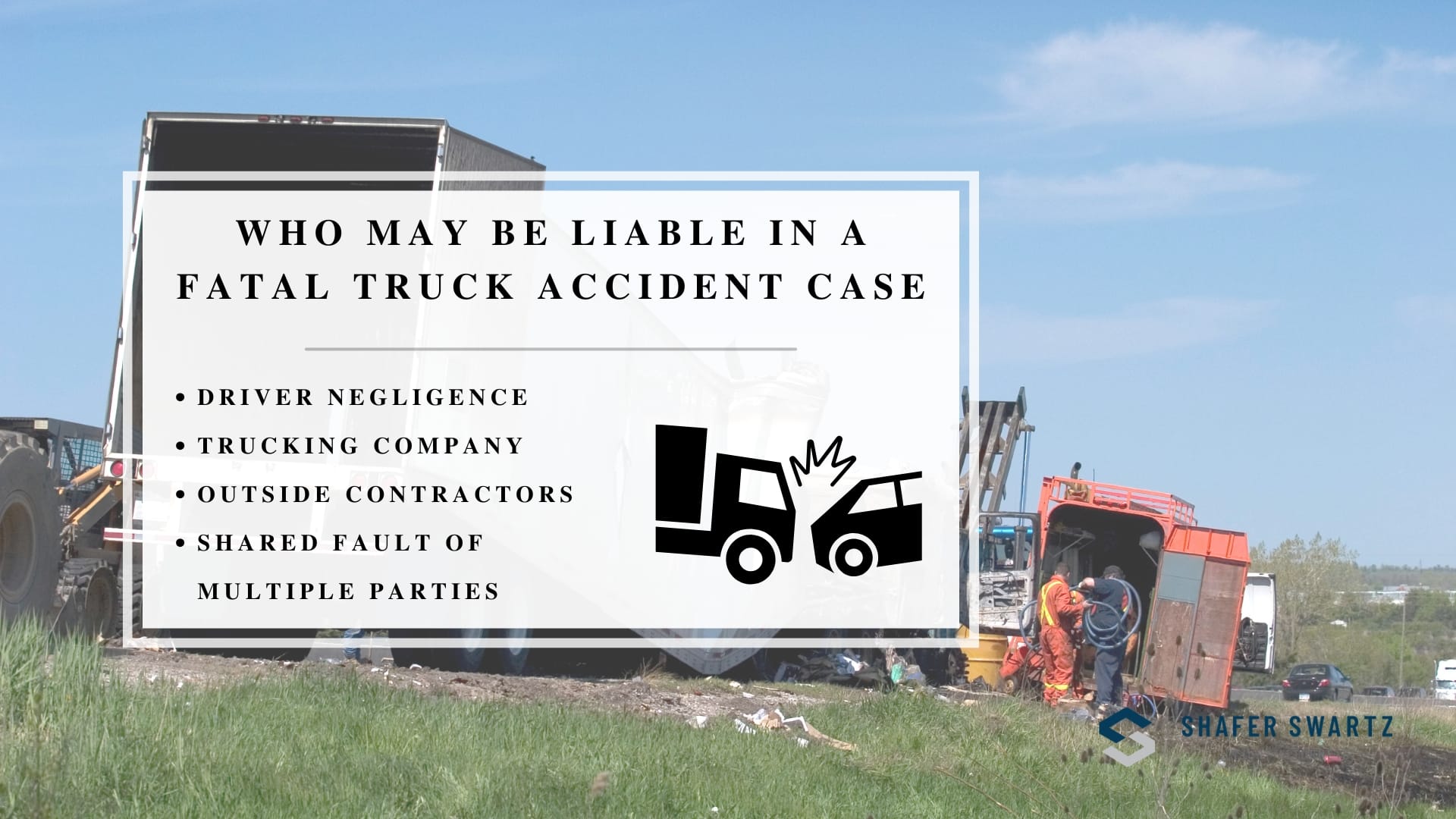
Who May Be Liable in a Fatal Truck Accident Case
Liability depends on what caused the crash and who had control over the driver, truck, cargo, or maintenance work. A complete investigation might even reveal that more than one party contributed to the fatal collision.
Driver Negligence
The truck driver might be responsible when careless conduct directly causes the crash. Examples include speeding, following too closely, driving while distracted, making an unsafe lane change, ignoring traffic signals, or failing to adjust to rain, snow, construction, or heavy traffic. Fatigue and impaired driving might further support a negligence claim. Investigators often review the electronic logging device of the truck, phone records, dash camera footage, delivery schedule, drug and alcohol testing records, and witness statements.
Trucking Company
A trucking company might be liable for its own actions or for negligence committed by a driver acting within the scope of employment. Direct claims might involve inadequate supervision, pressure to violate hours-of-service limits, or failure to remove an unsafe driver from the road. The owner liability rule provides another basis for responsibility. Under MCL 257.401, the owner of a motor vehicle can be liable for an injury caused by its negligent operation when the vehicle was driven with the express or implied consent or knowledge of the owner.
Outside Contractors
A maintenance contractor can face a claim for failing to properly inspect or repair worn brakes, tires, steering parts, lights, or other safety equipment. A cargo-loading company might be liable when an unsecured or uneven load shifts, falls from the trailer, or causes the truck to roll over. Meanwhile, a vehicle or parts manufacturer might be responsible when a defective brake system, tire, coupling device, steering component, or other product causes or worsens the collision. These claims often require technical inspections and expert witness analysis.
Shared Fault
Some fatal crashes result from several failures rather than one isolated mistake. For example, a driver might have been speeding while the trucking company encouraged an unrealistic delivery schedule. At the same time, a contractor might have failed to repair defective brakes. In these situations, the family can pursue claims against multiple parties. A qualified Michigan car accident attorney can gather records, work with accident reconstruction specialists, and build a clear account of how each action of the parties involved contributed to the fatal crash.
Challenges Families Face in Wrongful Death Truck Accident Cases
A wrongful death truck accident case can place a heavy burden on a family that’s already grieving. Trucking companies and insurers might begin investigating immediately, while surviving relatives might not yet know what evidence exists or which parties contributed to the crash.
Secure Evidence
Truck accident evidence can disappear or become harder to obtain as time passes. Electronic logging device data might be overwritten, surveillance videos might be deleted, and the truck might be repaired or returned to service. That’s why it’s paramount to act promptly so your local attorney can send preservation notices and request driver logs, maintenance records, inspection reports, dispatch messages, dash camera footage, and phone records. Photographs of the vehicles, roadway, skid marks, and surrounding conditions can further explain how the collision happened.
Investigations
Large trucking companies and their insurance carriers often have experienced investigators, lawyers, and claims representatives working on their behalf who might examine the crash scene, speak with the driver, inspect the truck, and gather records before your family understands what information is available. An insurance adjuster might challenge how the crash occurred, argue that another driver was responsible, or attempt to settle the claim before the full value of your losses is known. A thorough investigation can help prevent the company from controlling the explanation of the truck accident.
Financial Losses
The financial effect of a fatal truck accident can continue for many years. A wrongful death claim might include funeral and burial expenses, medical bills incurred before death, lost wages, lost future income, and the value of benefits the deceased person would have earned. Families can further pursue compensation for non-economic losses, including the loss of companionship, care, guidance, and emotional support, as well as conscious pain and suffering. Although no financial recovery can replace a loved one, a careful calculation of the losses helps show the full impact the death has had on the surviving family.
Protecting Your Family’s Rights After a Fatal Truck Accident
Shafer Swartz PLC can help your family pursue answers and accountability after a fatal truck accident in Michigan. Our experienced Michigan car accident attorney can investigate the driver, trucking company, vehicle owner, contractors, and other parties that might share responsibility. We can gather evidence, deal with insurance companies, and seek compensation for the financial and personal losses caused by the death of your loved one. Contact us today at (231) 722-2444 or here to schedule a consultation.