
After a Michigan car accident, you expect the bills tied to your treatment to be handled through insurance. But that’s not always what happens. In some cases, bills from the emergency room, imaging center, or follow-up providers keep moving through the normal billing cycle while your personal injury claim is still being reviewed. If the account has gone unpaid for too long, the bills might be transferred to a collection agency. Once that happens, the issue can become more frustrating and stressful, especially when you are still trying to recover.
If your medical bills are sent to collections, do not assume that you did something wrong or that you are personally stuck with every charge. It might mean the insurer has not processed the claim yet, or perhaps the coverage is being challenged. The important thing is to act quickly and understand how the Michigan no-fault rules affect what should happen next. Let our qualified Muskegon car accident attorney discuss further why bills can still go to collections after a crash and what Michigan victims should know about their rights and options.
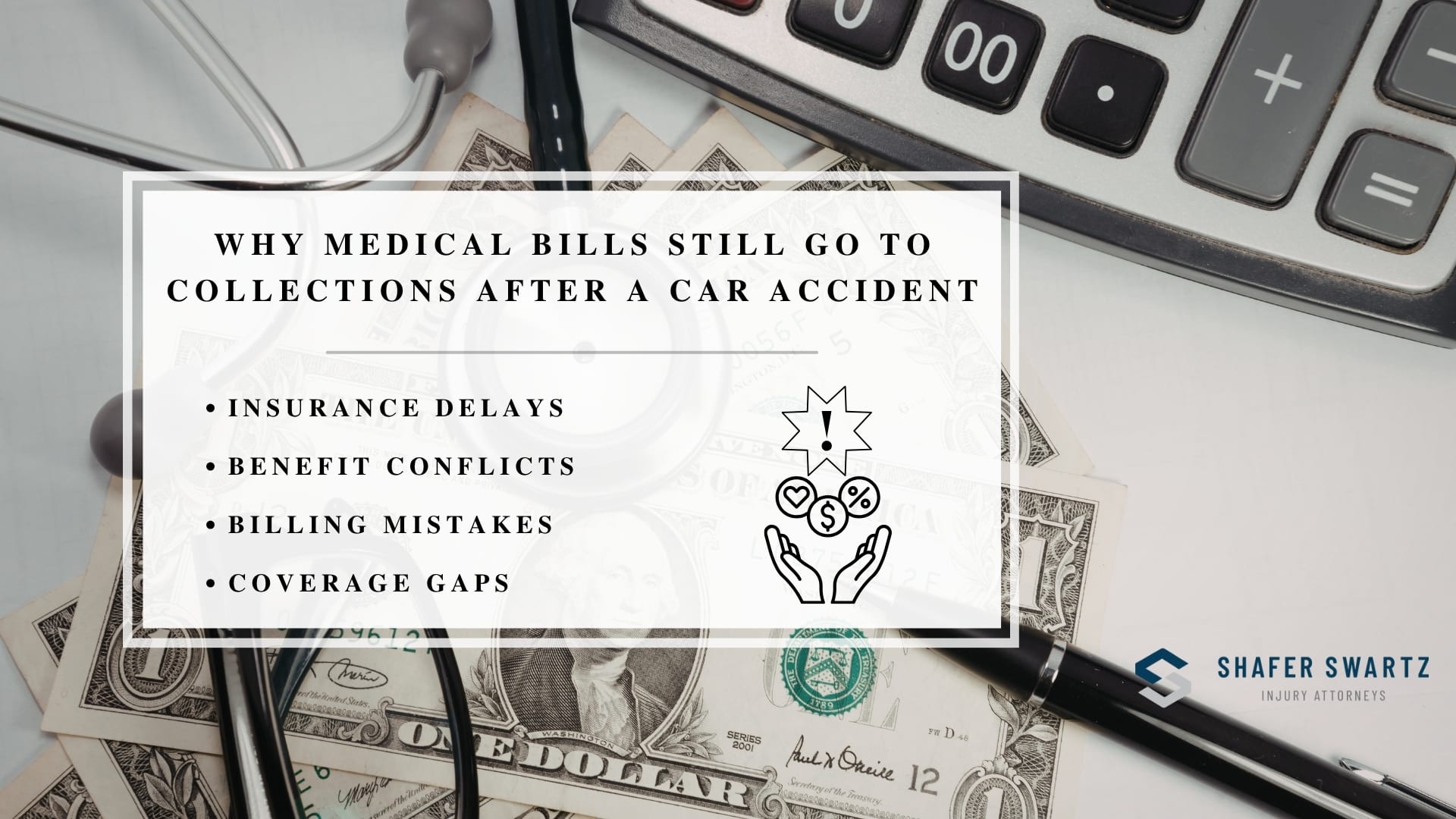
Why Medical Bills Still Go to Collections After a Car Accident
Even though the Michigan no-fault system is supposed to provide medical coverage after a car accident, billing problems still happen all the time. Providers, insurers, and patients are not always on the same page. A delay or mistake at any point in the process can leave a bill sitting unpaid long enough for it to be sent to collections. Here are some of the most common reasons:
Insurance Delays
After a crash, your provider might submit bills and supporting documents to the auto insurer. Still, the insurer might request more records, question whether the treatment was related to the accident, or simply take too long to review the claim. While that’s happening, the provider might continue treating the account as outstanding. From your point of view, it might seem unfair because you know a claim is pending. The provider, however, might still follow its own billing timeline and eventually turn the account over for collection activity if no payment arrives.
Benefit Conflicts
In some personal injury cases, there is a question about which insurer should pay first. Depending on the facts, payment might involve your own auto insurer, the insurer of a resident relative, Medicare, Medicaid, or a health insurer. If the wrong carrier is billed first, or if multiple insurers argue about responsibility, the claim can get stuck. When that happens, providers might not wait for the dispute to get sorted out before treating the balance as unpaid, and you might start receiving notices even though the real issue is not refusal to pay, but uncertainty over who should pay first.
Billing Mistakes
A hospital, clinic, therapy office, or imaging center might enter the wrong insurance information, bill your health insurer instead of your No-Fault carrier, omit required documentation, or fail to code the treatment accurately. Sometimes, the provider might not even have complete crash information in its file. Such billing mistakes can trigger a denial or stall payment long enough for the account to be sent to collections. Unfortunately, you might not realize there is a problem until you receive a demand letter.
Coverage Gaps
Some bills go to collections because there are gaps in coverage or disputed claims. An insurance adjuster might argue that certain treatment was not reasonably necessary, was excessive, or was unrelated to the crash. In other cases, a person might not have clear access to the expected coverage due to policy issues or limits that affect what gets paid. When payment is denied or only partially made, the unpaid portion can remain on your account with the provider. If the dispute is not addressed quickly, that unpaid balance can become a collection account.
Understanding Michigan No-Fault Medical Benefits
The Michigan no-fault law generally provides Personal Injury Protection (PIP) benefits for allowable medical expenses resulting from injuries in a motor vehicle accident. These benefits are meant to cover reasonably necessary products, services, and accommodations for your care, recovery, or rehabilitation. In many cases, the first question is not whether treatment was needed, but which insurer has priority to pay the claim. Priority rules matter because payment responsibility might depend on the policy covering you, a spouse, a resident relative, or another applicable source. If the wrong insurer is billed or the proper insurer is not identified, payment delays can follow.
Accident-related treatment often begins right away and might continue for weeks or months. Ambulance services, emergency room care, surgery, follow-up appointments, physical therapy, diagnostic imaging, and prescription costs can all become part of the claim. But even though PIP exists to address these losses, payment is not always automatic. Insurers might ask for proof that treatment was connected to the crash and whether the care was reasonably necessary. If the insurer denies the bill, delays payment, or only pays part of the charge, the provider might look at the patient account as unpaid while the dispute continues.
Note that in the case of Covenant Medical Center, Inc. vs. State Farm Mutual Automobile Ins. Co., the Michigan Supreme Court held that a medical provider does not have an independent cause of action against the insurer for payment under the no-fault act. In practical terms, that means providers cannot simply rely on their own direct lawsuit against the insurer when bills go unpaid. As a result, billing pressure might fall harder on the injured person. If an insurer, for instance, denies or delays payment, you might be the one receiving notices or facing medical bills sent to collections, even though the charges came from crash-related care.
Steps to Take If Your Medical Bills Are in Collections
If your crash-related medical bills have already been sent to collections, you still have a chance to correct errors and protect your claim. The key is to act quickly, stay organized, and avoid making decisions that could hurt your position later. Here are the steps you should take.
Get the Details
Request an itemized billing statement for every account that has been sent to collections. Ask for the dates of service, the specific charges, any payments already posted, adjustments made to the account, and the name of the collection agency handling the bill. A detailed statement gives you a clearer picture of what is really happening and helps you spot mistakes before you respond.
Notify Your Insurer
Once you know which bills are involved, notify your insurer in writing right away. A written notice creates a record that you informed the insurer that the bills remain unpaid. Include copies of the bills, collection letters, dates of treatment, and any claim information you already have. If you later need to prove that you acted promptly, your written notice can become valuable evidence.
Challenge Errors
If anything looks wrong, dispute the incorrect charges as soon as possible. A provider might have applied the wrong account information or listed treatment that was not related to your crash. These mistakes can lead to unfair collection activity if not corrected quickly. When you dispute a charge, be specific. Point out the exact problem and attach supporting documents if you have them.
Don’t Pay Immediately
It can be tempting to pay a collection bill immediately just to stop the calls and stress. But before you do that, take a step back. Premature payment can create problems, especially if the bill should have been paid through insurance benefits or is still being disputed. In some situations, paying too early may reduce your leverage when trying to force proper payment or reimbursement later.
Get Legal Help
When you are already dealing with injuries and stress, having someone protect your position can make the process far more manageable. A local Muskegon car accident attorney can help review the billing issues, identify whether the charges are proper, communicate with insurers and providers, and prevent payment problems from undermining your personal injury claim.
Protecting Your Financial and Legal Position After a Crash
When medical bills start piling up and collection notices begin arriving, it is easy to feel as if you have lost control of the situation. Shafer Swartz PLC understands how stressful these cases can be and how quickly billing issues can affect your recovery. Let our experienced Muskegon car accident attorney help you deal with insurance delays, disputed charges, and medical bills sent to collections while working to protect the compensation you might be entitled to pursue after a crash. Contact us today at (231) 722-2444 or here to discuss your situation and get the legal guidance you need to move forward.