
When you’re injured on someone else’s property, your ability to recover compensation depends on proving that the property owner was negligent. Property owners are legally obligated to keep their premises reasonably safe for visitors, but not automatically liable for every accident that happens on their property. In Michigan, proving that the property owner knew or should have known about the hazardous condition can make or break your personal injury claim.
Let our competent personal injury attorney in Muskegon discuss how the concept of notice works in Michigan premises liability cases and the difference between actual notice vs. constructive notice, so you can better understand your rights as an injured victim.
The Importance of Notice in Michigan Premises Liability Law
Under Michigan law, property owners owe a duty of reasonable care to those who enter their premises, meaning such owners must maintain their property in a way that minimizes risks to lawful visitors, but not to trespassers. When an owner fails to uphold such a duty, and you’re injured because of it, that owner might be liable for your damages. Proving that the property owner had notice of the property hazard is critical to establish that the owner acted negligently.
Notice refers to the awareness of the property owner of a dangerous condition, either through direct knowledge or because the condition existed long enough that the owner should have discovered it. Notice can either be actual or constructive. Since the Michigan open and obvious doctrine, which previously allowed property owners to avoid liability if the hazard was clearly visible, has been overruled, many defendants rely on the lack of notice argument to avoid liability.
What Is Actual Notice?
Actual notice means the property owner had direct knowledge of the hazard before the accident occurred. In other words, the owner was explicitly aware of the hazardous condition, either because the said owner saw it, received a complaint, or created the said condition. For example, a landlord receives written complaints from tenants about a broken stairway handrail, or a business owner sees ice forming at the entrance during freezing weather. In these situations, the owner knew the hazard existed, and the failure to take action might constitute negligence.
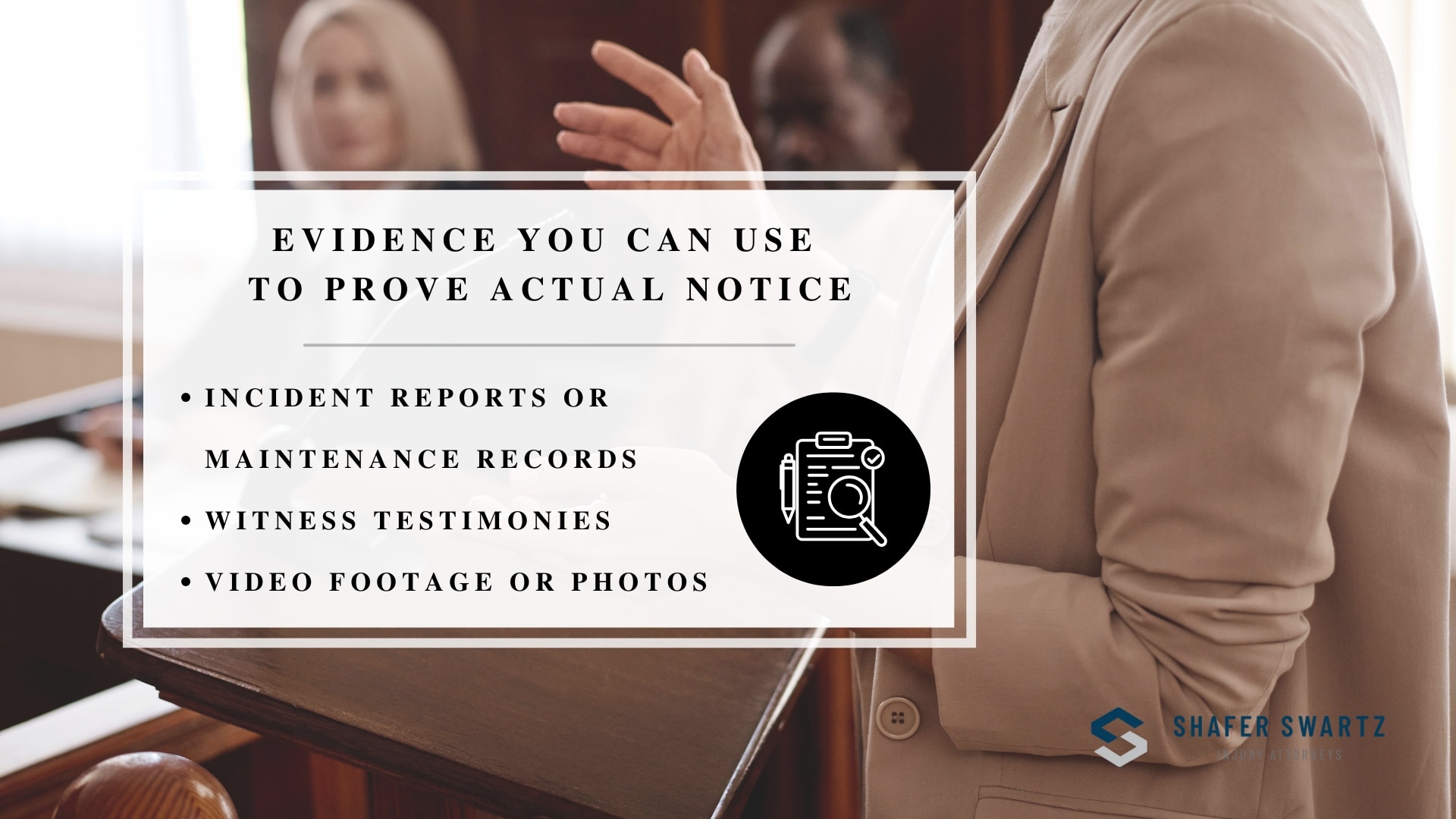
To prove actual notice, the injured party must show that the owner was truly aware of the danger before the incident, and that can be done through:
-
- Incident reports or maintenance records showing prior complaints or repair requests
- Testimony from employees or other visitors who informed management about the hazard
- Video footage or photos revealing that the owner or staff saw the condition but ignored it
Establishing actual notice strengthens a premises liability claim because it demonstrates that the owner consciously failed to take reasonable steps to protect lawful visitors.
What Is Constructive Notice?
While actual notice means the property owner knew about a danger, constructive notice applies when the hazard existed long enough, or was obvious enough, that a reasonable person in their position would have discovered and fixed the issue before anyone got hurt. For example, a jar of pasta sauce was spilled in an aisle of a grocery store, and that same spill remained for several hours while employees walked past without cleaning it. In that situation, the store might be held liable for any slip and fall incidents because the hazard lasted long enough, and the employees should have noticed and taken action.
Michigan courts often evaluate constructive notice by looking closely at certain factors. For instance, a hazard that existed for only a moment might not be enough to establish liability, but a condition that persists for a longer period might demonstrate negligence. Moreover, a highly noticeable defect is more likely to result in constructive notice than a subtle or hidden danger. Courts further examine how often the owner performs inspections or maintenance. If logs show long gaps between inspections, it can support the claim that the owner failed to act reasonably.
Challenges in Proving Notice
Proving notice, whether actual or constructive, isn’t always straightforward. Property owners and their insurance companies often raise several defenses to deny liability or minimize payouts. Common arguments include a lack of awareness of the hazard and that the owner couldn’t reasonably have discovered it before the accident. Sometimes, owners contend that the hazard appeared too quickly for them to take preventive measures.
Even when notice can be shown, property owners often use comparative negligence to reduce their liability. Under Michigan law, if you are found partially at fault for your injury, for example, being distracted or wearing unsafe footwear, your compensation may be reduced by your percentage of fault. In some cases, if you are 51% or more at fault, you might be barred from recovering non-economic damages, such as pain and suffering, entirely.
These challenges are exactly why many injured individuals turn to a local personal injury attorney in Muskegon who knows how to establish a clear timeline of events to prove notice and counter the defense claims. These legal professionals can help gather surveillance footage, inspection records, witness accounts, and even expert witness testimony to show that the owner had a clear opportunity to prevent the hazard, yet failed to act.
Why You Need a Michigan Premises Liability Attorney
Shafer Swartz PLC has handled countless Michigan premises liability cases. We know what it takes to prove constructive or actual notice and hold negligent property owners accountable. Our seasoned personal injury attorneys in Muskegon are prepared to investigate thoroughly and advocate for your right to fair compensation. Contact us today at (231) 722-2444 or here for a consultation. Let us review your case, explain your options, and help you pursue the justice and recovery you deserve.