
When you are hit with a rear-end accident, you might hear the other driver claim that you “stopped too fast.” In Michigan car accident cases, that becomes the center of the dispute. The issue is often whether the front driver acted in a way that was truly unexpected and unreasonable, or whether the rear driver simply failed to leave enough space and react in time. That matters because fault affects how an insurance claim or car accident lawsuit develops, especially when both sides tell very different stories about what happened in the seconds before impact.
Let our local Grand Haven personal injury attorney elaborate on Michigan rear-end accidents, sudden stop defenses, and the evidence used to prove fault.
Why Rear-End Drivers Are Usually Presumed at Fault
In Michigan, drivers have a basic duty not to follow another vehicle more closely than is reasonable and prudent under the traffic and road conditions. The law applies a rebuttable presumption of negligence to the driver who strikes the rear of another vehicle. In plain terms, if you hit the car in front of you, you are presumed to be at fault because you were either following too closely, not paying enough attention, or driving too fast to stop safely. That presumption, however, does not mean automatic liability in every circumstance, but it gives the injured person a strong starting point when proving fault in a rear-end accident.
What the “Sudden Stop” Defense Actually Means
The “sudden stop” defense is an attempt to explain why the presumption of fault should not apply in full force. The argument is usually that the front driver braked so abruptly and unreasonably that a reasonably careful driver could not have avoided the rear-end accident. For example, a driver might argue that the lead vehicle slammed on its brakes in moving traffic for no clear reason, or that the lead driver cut in too closely and stopped almost immediately. In another version, the rear driver might say a sudden mechanical failure or other emergency made it impossible to avoid the impact.
Once a sudden stop claim is raised, the rear driver has the burden of producing evidence strong enough to rebut the presumption of negligence. Michigan courts do not treat the “I didn’t expect them to stop” excuse as enough, because drivers are expected to anticipate ordinary traffic changes and maintain enough space to stop within the assured clear distance ahead. Courts examine the full situation, including traffic flow, distance between vehicles, weather, visibility, and speed. If the stop was simply part of ordinary driving conditions, the presumption against the rear driver remains in place.
Evidence That Determines Fault in Rear-End Cases
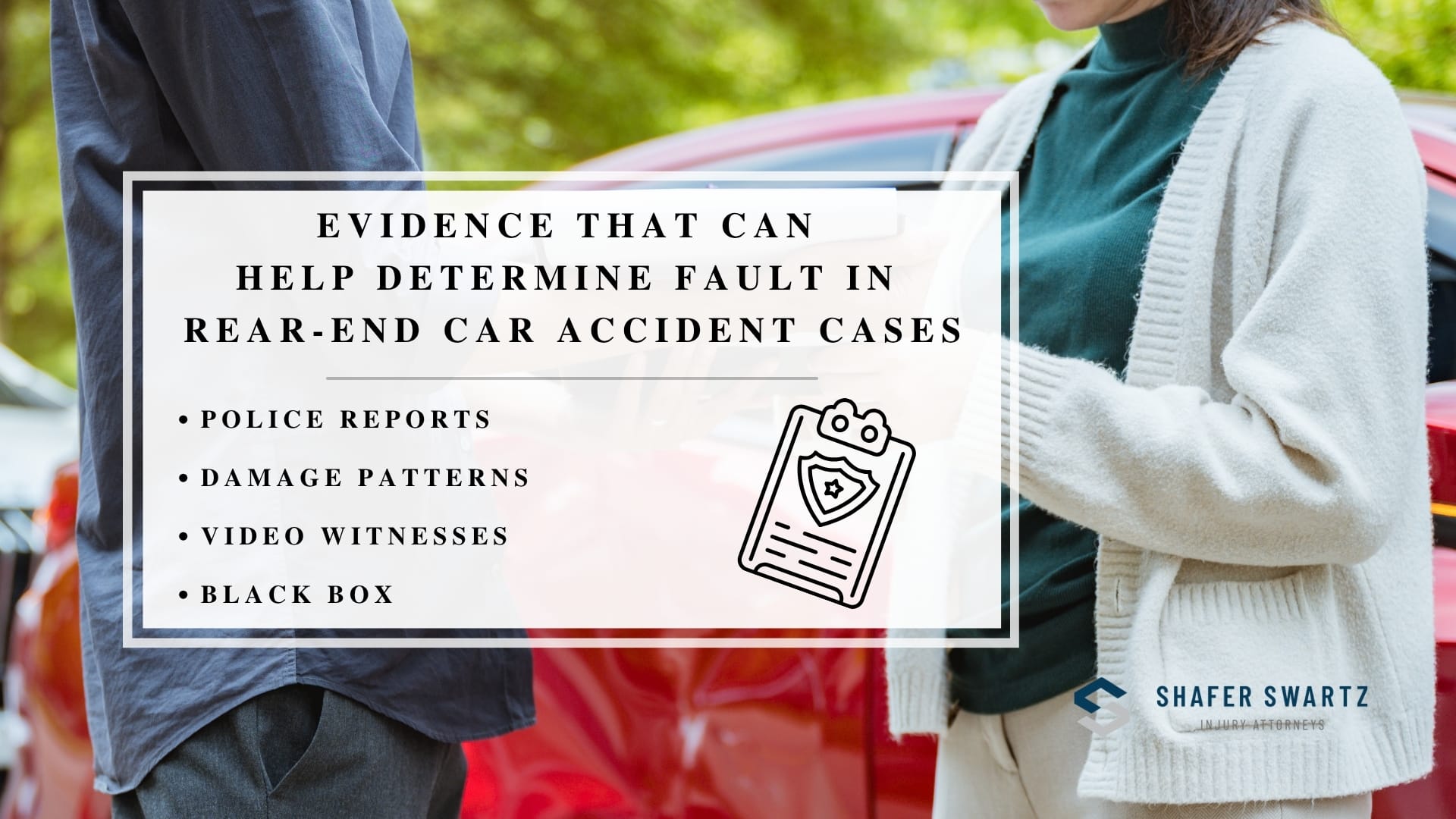
Proving fault in a rear-end accident often comes down to the details left behind after the crash. While Michigan law gives injured drivers a strong starting point when the rear vehicle strikes the car ahead, that presumption can still be challenged. That’s why the evidence matters so much. Courts and insurance adjusters look closely at the physical facts, the records made at the scene, and any digital evidence that shows what each driver was doing just before impact.
Police Reports
Police reports and crash scene documentation provide the first clear picture of what happened. The report might identify where the vehicles were located, whether skid marks were present, what each driver said, whether a citation was issued, and what road or weather conditions existed at the time. Photos taken at the scene can help show lane position, traffic controls, debris patterns, and stopping distance. While a police report does not automatically decide liability on its own, it can strongly support your version of events when the other driver claims a sudden stop car accident was unavoidable.
Damage Patterns
Vehicle damage patterns and impact points can tell an important story. In many cases, the location and severity of damage can show whether the rear driver hit the lead vehicle squarely from behind, tried to swerve at the last second, or struck with enough force to suggest delayed braking or following too closely. Damage can help test the claim of a driver that the front vehicle stopped in an unusual way. If the physical evidence does not match the story being told, that weakens the defense. In a rear-end accident, the damage pattern often confirms which vehicle initiated the impact and how the collision unfolded.
Video Witnesses
Dashcam footage and witness statements can be some of the most persuasive evidence in disputed cases. A dashcam might show traffic flow, brake lights, lane changes, road hazards, or whether the front driver actually brake-checked. Independent witnesses can further help determine whether the stop was normal for the traffic conditions or whether something truly unusual occurred. Such evidence matters because Michigan courts look beyond a driver’s personal claim that the stop was unexpected and examine whether the event was objectively unforeseeable under the circumstances.
Black Box
Black box data, or event data recorder (EDR) information, can provide a more technical look at the seconds before a crash. Depending on the vehicle, it might show speed, braking, throttle use, seatbelt status, and timing before impact. That can be especially useful when one driver says the stop was sudden, while the other says the rear driver was not paying attention or was not following at a safe distance. When available, such information can either support or undermine a sudden stop defense by showing whether the rear driver reacted in time and whether the movement of the front vehicle was as abrupt as claimed.
Comparative Fault in Michigan Car Accident Cases
Michigan follows the comparative negligence rule, meaning an injured person’s compensation can be reduced by that person’s percentage of fault. In some cases, the front driver might still share liability even though the rear driver is presumed negligent. That can happen if the lead driver made an unsafe lane change, stopped unlawfully, had inoperative brake lights, or engaged in reckless conduct that contributed to the crash. Michigan law provides that damages are reduced by the injured person’s percentage of comparative fault, and noneconomic damages, such as pain and suffering, are not awarded to a party who is more than 50% at fault.
For instance, a driver suddenly cuts into your lane and slams on the brakes, and you then strike that vehicle from behind. The court might find the other driver responsible for creating the hazard, but might still assign part of the blame to you for following too closely. In that situation, if your damages are $100,000 and you are found 20% at fault, your recovery might be reduced to $80,000. That’s one reason these cases are often heavily contested. Insurance companies frequently look for ways to shift more blame onto you to reduce or deny your personal injury claim, which is why working with a seasoned Grand Haven personal injury attorney can be important when a rear-end accident turns into a fault dispute.
Protecting Your Claim After a Rear-End Collision
Even when the other driver seems clearly at fault, insurance companies might still look for ways to weaken your case by focusing on your statements or any gaps in the evidence. One of the biggest mistakes you can make is giving a recorded statement too quickly without understanding how your words might be used later. A simple comment, such as “I’m okay” or “I stopped fast,” can be taken out of context and used to minimize your injuries or shift blame. It’s better to be careful, stick to the basic facts, and avoid guessing about fault before the evidence is fully reviewed.
If you were hurt in a rear-end accident and the other driver is trying to avoid responsibility, having the right legal support can help protect both your case and your recovery. Let Shafer Swartz PLC help you push back against unfair blame and build strong, evidence-based claims. Our competent Grand Haven personal injury attorney can help preserve crash scene evidence, review police reports and footage, obtain witness statements, and deal with insurance adjusters who are trying to reduce or deny your claim. Contact us today at (231) 722-2444 or here for a consultation.