

If you’ve been hurt in a Michigan car crash, a slip-and-fall, or other accident, you’ve probably heard someone say, “You can sue for pain and suffering if your injury is serious.” In Michigan, the word serious has a very specific meaning. It’s not just about how much you hurt or how frustrating recovery feels. It’s about whether your injury meets a legal threshold that opens the door to compensation for non-economic damages.
That’s why two people can be in similar accidents and have very different legal outcomes. One might qualify for a pain and suffering claim, while the other might not, even if both needed treatment. Understanding the “serious injury” standard helps you set realistic expectations and talk more clearly with a personal injury attorney in Muskegon about what your case might be worth under Michigan personal injury law.
So, what exactly makes an injury serious enough? Let’s explore how Michigan defines a serious injury and what you must show to meet that threshold.
Understanding Michigan’s Serious Injury Threshold
Michigan follows a no-fault insurance system, meaning your auto insurance covers your medical bills and lost wages after a car crash, regardless of who caused it, through Personal Injury Protection (PIP). However, PIP is not meant to compensate you for the personal impact of the injury, such as ongoing pain or the way the injury changes your day-to-day life. If you want to pursue those non-economic damages, you must meet a threshold injury standard known as “serious impairment of body function” under MCL 500.3135.
Not all injuries qualify, even when treatment is necessary. Michigan personal injury law sets a specific standard to limit such personal injury lawsuits to cases involving more significant harm. The purpose of the threshold is to prevent minor personal injury claims from overwhelming the courts while still allowing people with real, life-altering injuries to seek full compensation. In other words, the law draws a line between temporary discomfort and injuries that meaningfully interfere with how you live, work, and function.
How Michigan Law Defines “Serious Impairment”
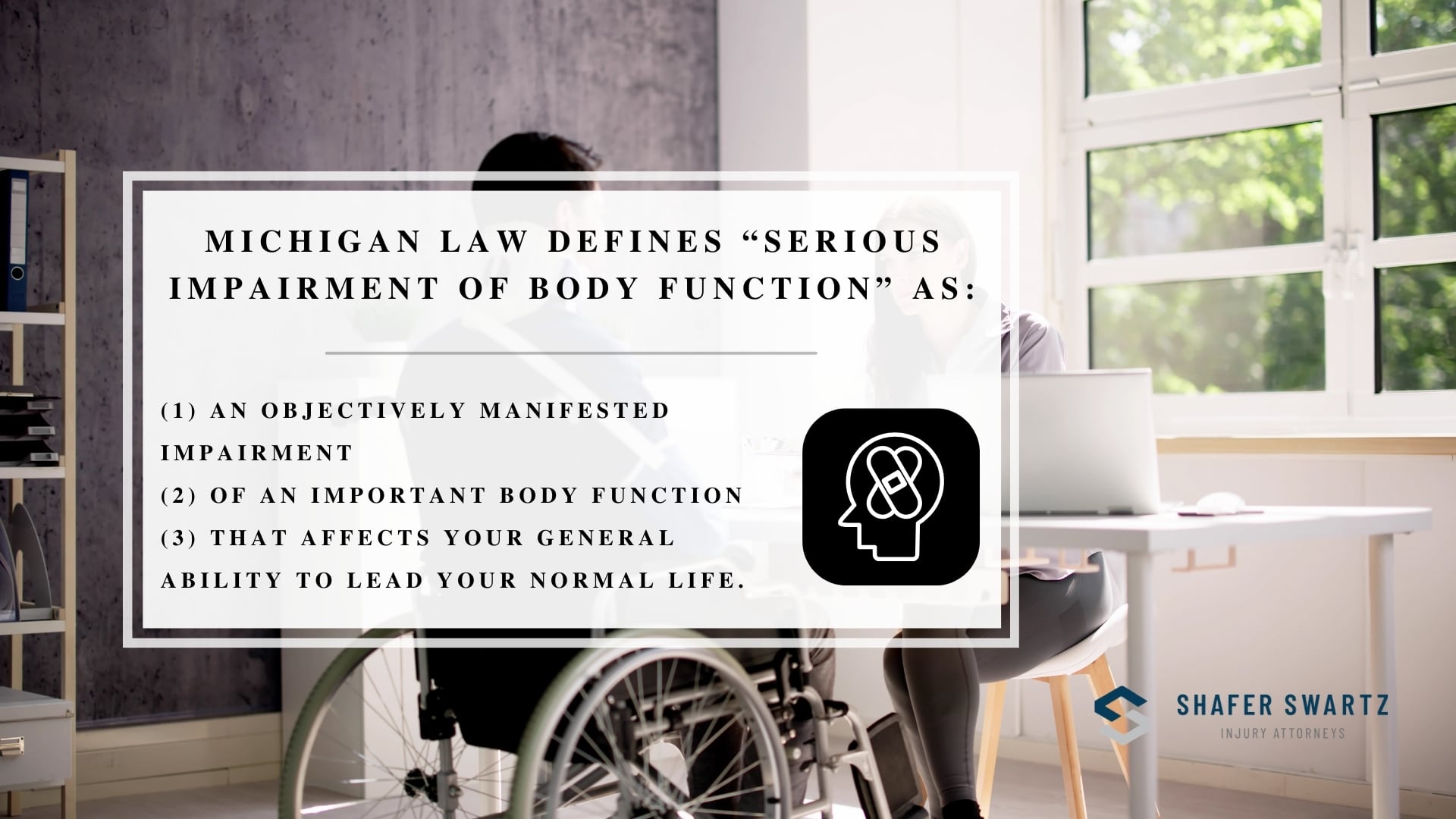
Michigan personal injury law defines a “serious impairment of body function” as (1) an objectively manifested impairment (2) of an important body function (3) that affects your general ability to lead your normal life.
What Does Objectively Manifested Mean?
Objectively manifested means the impairment isn’t based only on what you say you feel, but something that can be observed, measured, or confirmed through evidence. There needs to be documentation, such as imaging results, physician observations, or other clinical findings that show a physical basis for the injury. For example, a herniated disc confirmed by an MRI might qualify, while general soreness without medical findings might not.
What Counts as an Important Body Function?
An important body function is one that plays a meaningful role in how you live your daily life. Think of functions that allow you to move, work, care for yourself, communicate, or otherwise handle normal tasks, such as walking, lifting, seeing, hearing, or concentrating. An injury that limits overhead lifting, for instance, might be a bigger deal for a mechanic, warehouse worker, nurse, or parent who frequently carries a child than it is for someone who rarely uses that motion.
How Significantly Must the Injury Affect Your Normal Life?
It doesn’t mean your entire life must stop. And it doesn’t require you to be permanently disabled. Instead, the question is whether the impairment affects your general ability to live your normal life. That includes your routine, your work capacity, your household responsibilities, and the activities that filled your days before the injury. Courts often look at what you used to do, what you can’t do now, what you can only do with difficulty, and how long those changes last.
Injuries That May Meet the Serious Impairment Standard
Personal injuries that create clear, lasting limits on how you function often meet the Michigan serious impairment standard. Examples can include traumatic brain injuries, spinal injuries such as herniated discs with nerve involvement, fractures that require surgery, serious shoulder or knee injuries that limit mobility, and injuries that result in long-term work restrictions. But it’s essential to understand that there is no automatic list. A diagnosis alone does not guarantee that your injury meets the legal threshold.
Severity is about impact. A back injury that heals quickly and allows you to return to normal activities might not qualify, even if it was painful. On the other hand, a soft tissue injury that leads to months of work restrictions and limited mobility might meet the standard. Courts further examine the duration and how deeply those limitations interfere with your daily routine. The longer and more disruptive the impact, the stronger the argument that your injury meets the serious impairment requirement.
How Insurance Companies Challenge Serious Injury Claims
Insurance companies often try to argue that your injury is not “serious enough” to cross the legal threshold, and might claim your condition is temporary, minor, or related to a pre-existing issue rather than the accident itself. Insurance adjusters frequently point to gaps in treatment, missed appointments, or medical records that do not clearly describe limitations, and might even hire medical experts to review your records and suggest that your symptoms are exaggerated or unsupported by objective findings.
Furthermore, insurers might highlight social media posts or isolated activities to argue that you are functioning better than you claim. That’s why early documentation matters. These include detailed medical records, consistent treatment, and clear evidence of how your daily life has changed. Working with a local personal injury attorney in Muskegon early in the process can help you build a strong strategy, protect your claim from common insurance tactics, and present a clear picture of how the injury has truly affected you.
Why You Should Speak With a Michigan Personal Injury Attorney
Proving that your injury meets the legal threshold for pain and suffering damages takes more than frustration or even a diagnosis. It requires medical records, clear documentation, and a strong explanation of how your injury has affected your normal life. If you wait too long or say the wrong thing to an insurance adjuster, it can hurt your case. That’s why it’s important to speak with a legal professional who knows how the Michigan serious impairment standard works.
Shafer Swartz PLC understands what it takes to build a strong serious impairment claim. Our experienced personal injury attorney in Muskegon can review your situation, explain your options in plain language, and help you take the next step with confidence. We take the time to gather the right evidence and present your case in a way that fits the legal requirements. If you’ve been injured and you’re not sure whether your case qualifies as serious, contact us today at (231) 722-2444 or here to schedule a consultation.