
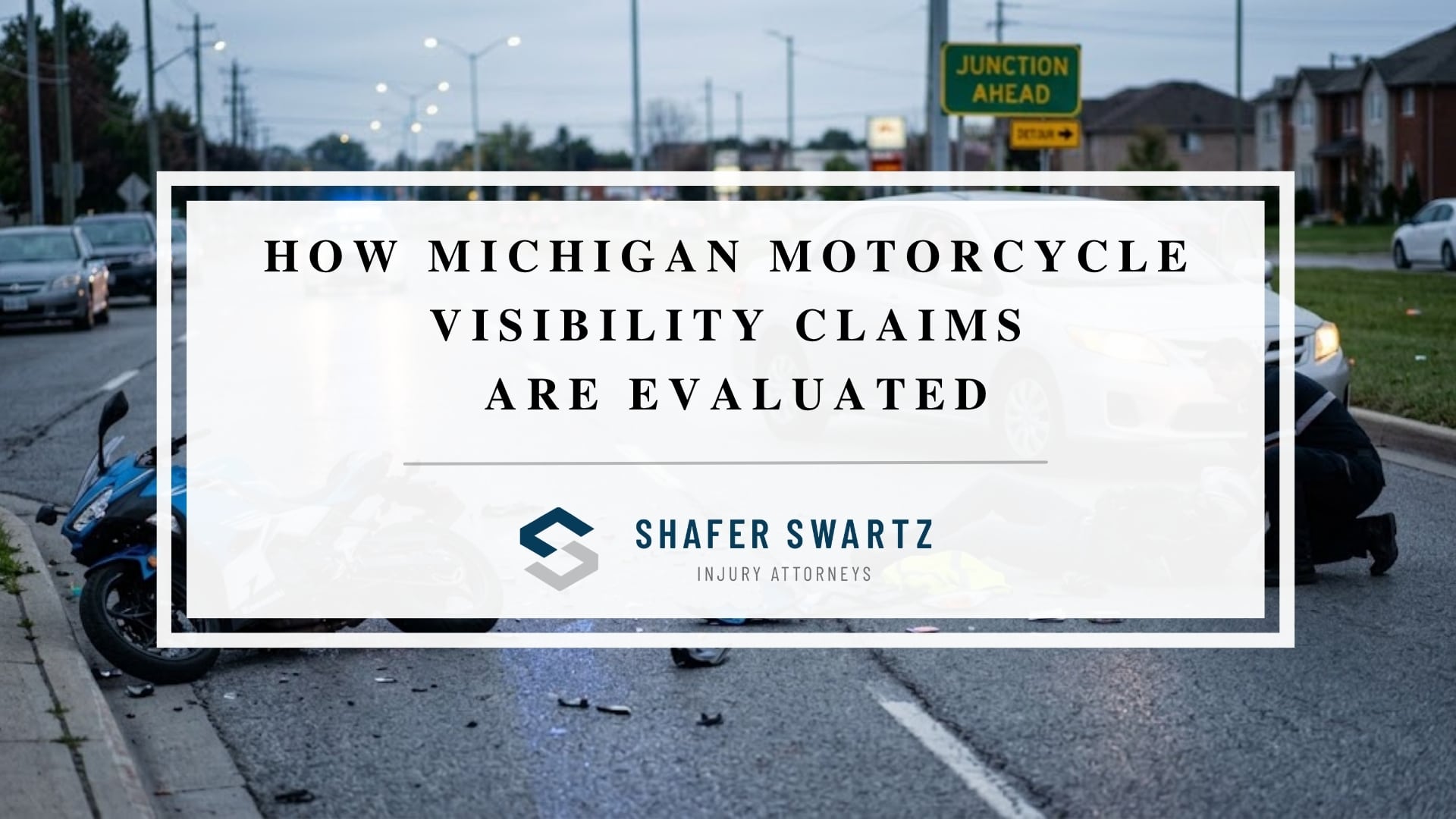
Michigan recorded 2,892 motorcycle-involved crashes in 2025, along with 151 motorcyclist fatalities. These crashes show why driver awareness and motorcycle visibility remain important safety and liability concerns. Motorcycles are smaller than cars and trucks, making them easier to overlook and sometimes harder to judge from a distance. But poor visibility does not automatically mean the crash was unavoidable. In many cases, the key question is whether a reasonably careful driver should have seen the rider in time to avoid the collision.
Visibility disputes can affect how fault is assigned and how insurance companies evaluate a personal injury claim. When a driver causes a motorcycle accident and says, “I didn’t see the rider,” that statement can become an issue when determining fault. If you were injured, a Muskegon motorcycle accident attorney can help evaluate whether the poor visibility claim of the driver matches the physical evidence. Let’s explore how motorcycle visibility claims are evaluated, the defenses that might arise, and the evidence that can help establish fault.
Why Motorcycle Visibility Becomes a Major Liability Issue
Motorcycles have a smaller visual profile than most passenger vehicles. A driver looking toward an approaching motorcycle might have difficulty estimating its speed and distance, particularly at an intersection, and that can become especially dangerous when a vehicle turns left across the path of an oncoming rider. Michigan motorcycle safety information has consistently identified intersections and left-turn situations as major sources of multi-vehicle motorcycle crashes. A driver might claim the motorcycle “came out of nowhere,” but the evidence might show that the rider was visible for several seconds before the turn began.
The same concerns apply to lane changes and merges. A driver who moves into another lane without properly scanning traffic might overlook a motorcycle traveling in an adjacent lane. In Michigan, drivers are mandated to remain within a single lane as nearly as practical and cannot move from that lane until determining that the movement can be made safely. The law further requires a driver making a left turn to yield to approaching traffic that is within the intersection or close enough to create an immediate hazard. That’s why saying “I didn’t see the rider” does not automatically excuse a driver from responsibility.
How Driver Perception Is Evaluated After a Crash
A motorcycle visibility claim often starts with timing and distance. Investigators might examine the sightline of the driver, the approach of the rider, the distance between the vehicles before impact, traffic signals, road hazards, and whether another vehicle or object blocked the view. Phone use, conversations with passengers, looking in the wrong direction, or failing to scan traffic carefully can weaken an argument that the rider simply appeared too late to avoid. In a left-turn motorcycle accident, for example, investigators might compare the approach of the rider with the point when the turning driver began crossing the lane.
Expert witnesses can sometimes provide additional insight. Reconstruction specialists, for instance, can review vehicle damage, road markings, skid marks, electronic vehicle data, photographs, and video to estimate speed and vehicle positions. Meanwhile, human-factors experts can analyze what a driver could reasonably have perceived and how much time was available to respond. These professionals can be helpful when a driver raises a poor visibility claim. Expert analysis does not replace other objective evidence, but it can test whether the explanation of the driver is consistent with the physical facts.
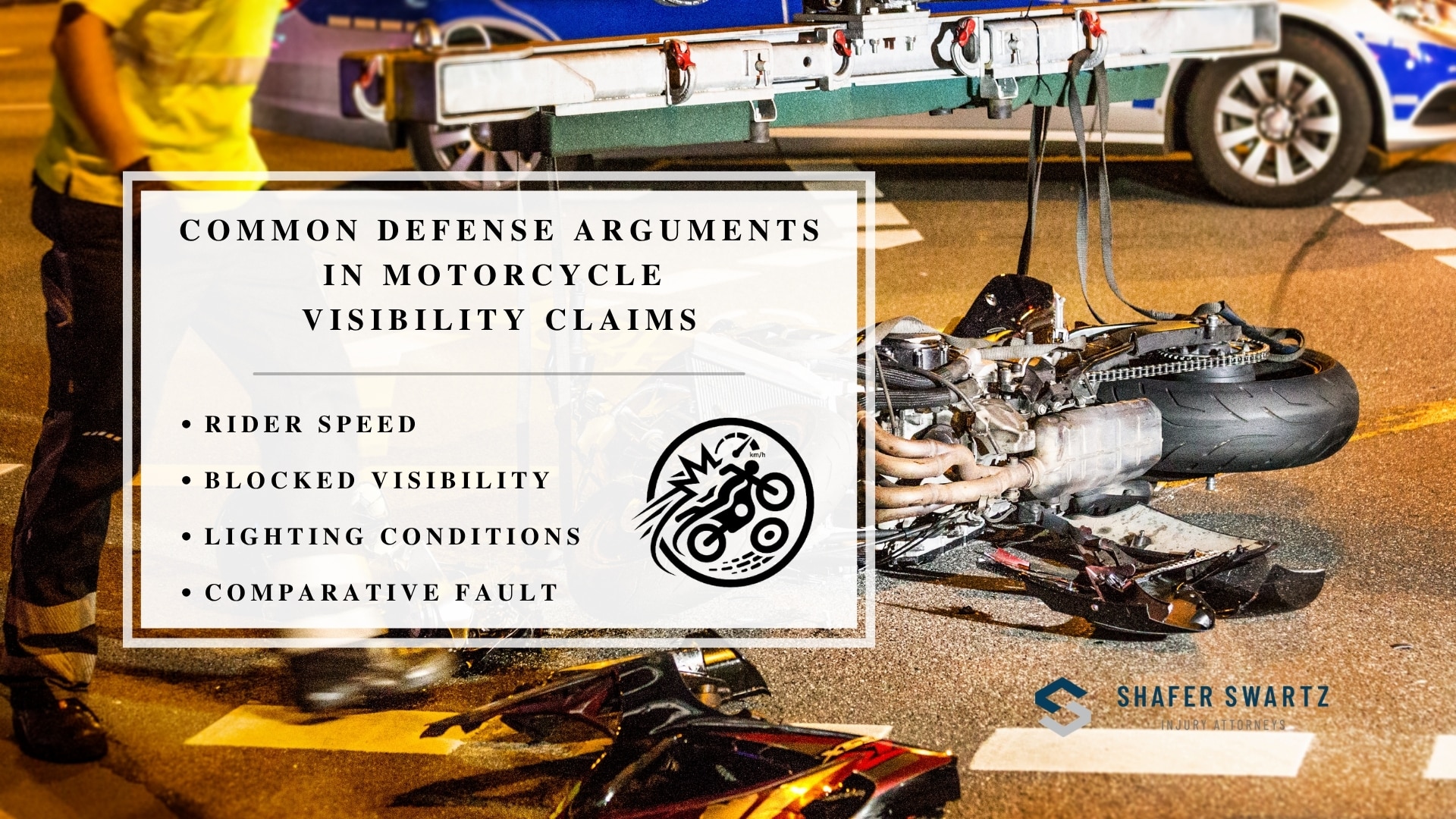
Common Defense Arguments in Motorcycle Visibility Claims
Insurance adjusters and defense attorneys might argue that the rider, rather than the driver, created or contributed to the visibility problem. These arguments can affect a motorcycle visibility claim, but each should be evaluated against the evidence instead of accepted at face value.
Rider Speed
The defense might argue that the rider was speeding and approached too quickly for the driver to judge the distance accurately. Motorists are generally required to travel at a careful and prudent speed that is reasonable under existing road and traffic conditions. Surveillance footage, dashcam video, electronic data, road measurements, witness accounts, or accident reconstruction can help determine how fast the motorcycle was actually traveling. Even when speed is disputed, investigators must still examine whether the other driver properly looked for approaching traffic and followed applicable right-of-way rules.
Blocked Visibility
A legitimate obstruction, including a larger vehicle, a curve, roadside objects, glare, rain, darkness, or other environmental conditions, can affect a poor visibility claim, particularly when the rider only became visible immediately before impact. Still, limited sight distance requires a driver to use greater caution. Investigators often review surveillance video, dashcam footage, roadway geometry, weather records, and witness descriptions to determine when the rider first became visible, and consider whether the driver moved forward, turned, or changed lanes despite not having a clear view of approaching traffic.
Lighting Conditions
A defense might focus on the motorcycle headlights and the lighting conditions at the time of the crash. Michigan vehicles must display their required lights from one-half hour after sunset to one-half hour before sunrise and whenever there is insufficient light to clearly see people and vehicles 500 feet ahead. Moreover, a motorcycle must have at least one compliant headlamp. The condition and operation of a motorcycle lighting system can therefore impact the evaluation of fault in a nighttime or low-light crash. Dark clothing might be discussed as part of the overall visibility evidence, but it does not necessarily establish fault.
Comparative Fault
Michigan follows comparative fault principles in personal injury cases. Compensation might be reduced based on the percentage of fault. In certain circumstances, being found more than 50% at fault can prevent recovery of noneconomic damages, such as pain and suffering. Because comparative fault can directly affect compensation, insurers may focus heavily on allegations involving speed, signaling, lane position, or visibility. A local Muskegon motorcycle accident attorney can investigate these allegations and compare them with physical evidence, witness accounts, video footage, and applicable traffic laws.
Protecting Your Rights After a Visibility-Related Motorcycle Crash
Evidence from a motorcycle crash can disappear quickly. If you are able to do so safely, preserve photographs and video of the motorcycles and vehicles involved, road markings, traffic lights, signs, weather conditions, and surrounding sightlines. Identify nearby homes or businesses that may have surveillance cameras, and save helmet-camera or dashcam footage when available. Be cautious about giving statements or making casual comments before you fully understand the evidence, because an incomplete statement can later be used to shift blame.
Shafer Swartz PLC can review the circumstances of the crash, preserve relevant evidence, examine driver and witness accounts, and determine whether reconstruction or other expert analysis can help explain what happened. Our experienced Muskegon motorcycle accident attorneys can respond to attempts to place unfair blame on you for being difficult to see and build a personal injury claim based on the full record of the incident. Contact us today at (231) 722-2444 or here to discuss what happened and the steps you can take to protect your rights.